Mary Oliver I Want to Think Again of Dangerous Things Print With Feather
The dangerous downsides of perfectionism
(Paradigm credit:
Getty Images
)

Many of united states of america believe perfectionism is a positive. But researchers are finding that it is nothing curt of dangerous, leading to a long list of health problems – and that it's on the ascent.
I
In i of my earliest memories, I'm cartoon. I don't call up what the motion-picture show is supposed to exist, but I call up the fault. My marker slips, an unintentional line appears and my lip trembles. The picture has long since disappeared. Only that feeling of deep frustration, even shame, stays with me.
More oft than I'd like to admit, something seemingly inconsequential will crusade the same feeling to rear its head over again. Something as small-scale as accidentally squashing the panettone I was bringing my boyfriend's family for Christmas tin can tumble around in my mind for several days, accompanied by occasional voices similar "How stupid!" and "You lot should have known ameliorate". Falling short of a bigger goal, even when I know achieving it would be near-impossible, can temporarily flatten me. When an agent told me that she knew I was going to write a book someday but that the detail idea I'd pitched her didn't arrange the market, I felt deflated in a gut-punching style that went beyond disappointment. The negative drowned out the positive. "You're never going to write a book," my internal voice said. "You're not skillful enough." That vocalism didn't care that this directly contradicted what the agent actually said.
That's the thing nearly perfectionism. It takes no prisoners.
Yous might as well like:
• Is social media bad for yous?
• Why exhaustion and burnout are and then mutual
• The surprising downsides of being clever
If I've struggled with perfectionism, I'm far from solitary. The tendency starts young – and it'south becoming more common. Thomas Curran and Andrew Colina's recent meta-analysis of rates of perfectionism from 1989 to 2016, the kickoff study to compare perfectionism across generations, found significant increases amid more recent undergraduates in the United states, UK and Canada. In other words, the boilerplate college student concluding yr was much more probable to have perfectionistic tendencies than a student in the 1990s or early 2000s.
"As many as two in v kids and adolescents are perfectionists," says Katie Rasmussen, who researches child development and perfectionism at Westward Virginia University. "We're starting to talk about how it's heading toward an epidemic and public health issue."
The rising in perfectionism doesn't mean each generation is becoming more accomplished. It means nosotros're getting sicker, sadder and even undermining our ain potential.

'My life has been zero but a failure,' perfectionist Claude Monet in one case said. He often destroyed paintings in a atmosphere – including fifteen meant to open an exhibition (Credit: Getty)
Perfectionism, afterwards all, is an ultimately self-defeating fashion to motion through the world. It is congenital on an excruciating irony: making, and admitting, mistakes is a necessary part of growing and learning and being human. Information technology too makes you better at your career and relationships and life in general. By avoiding mistakes at any cost, a perfectionist can go far harder to reach their own lofty goals.
But the drawback of perfectionism isn't just that it holds you back from being your about successful, productive cocky. Perfectionistic tendencies have been linked to a laundry list of clinical issues: depression and anxiety (even in children), self-harm, social anxiety disorder and agoraphobia, obsessive-compulsive disorder, binge eating, anorexia, bulimia, and other eating disorders, post-traumatic stress disorder, chronic fatigue syndrome, insomnia, hoarding, dyspepsia, chronic headaches, and, most damning of all, fifty-fifty early mortality and suicide.
"It's something that cuts across everything, in terms of psychological problems," says Sarah Egan, a senior inquiry fellow at the Curtin University in Perth who specialises in perfectionism, eating disorders and anxiety. "At that place aren't that many other things that do that.
"There are studies that propose that the higher the perfectionism is, the more psychological disorders you're going to suffer."
*
Culturally, nosotros often run across perfectionism as a positive. Even saying you have perfectionistic tendencies can come off as a coy compliment to yourself; it's practically a stock reply to the "What'southward your worst trait?" question in job interviews. (By employers, at present you lot know! I wasn't simply being cute).
This is where perfectionism gets complicated – and controversial. Some researchers say at that place is adaptive, or 'healthy' perfectionism (characterised by having high standards, motivation and bailiwick) versus a maladaptive, or 'unhealthy' version (when your best never seems good plenty and not meeting goals frustrates y'all). In one written report of more than i,000 Chinese students, researchers found that gifted students were more than perfectionistic in the adaptive ways. (Maladaptive perfectionists, on the other hand, were more likely to be non-gifted). And while enquiry shows that maladaptive attributes like chirapsia yourself up for mistakes or feeling like you can't alive up to parental expectations make you lot more than vulnerable to depression, some other studies accept shown that 'adaptive' aspects like striving for achievement have no effect at all or may even protect you.

Footballer Cristiano Ronaldo says he strives for excellence, not perfection: 'I am non a perfectionist, but I like to feel that things are done well' (Credit: Getty Images)
But that isn't always the example. Simply having high personal standards has been linked to suicide ideation, for example. And even if at that place sometimes may be upsides to perfectionist thinking, they are pocket-sized – and, researchers debate, misunderstood.
In a 2016 meta-analysis of 43 studies on perfectionism and burnout, for example, Hill and Curran plant that athletes, employees and students experienced either a tiny or no benefit from aspects like having very loftier personal standards, compared to people who didn't have them. People who expressed more 'maladaptive' perfectionism, on the other mitt, experienced significantly more than exhaustion.
"There has been some proffer that, in some cases, perfectionism might be healthy and desirable. Based upon the threescore-odd studies that we've done, we think that's a misunderstanding," says York St John University'south Hill. "Working hard, being committed, diligent, so on – these are all desirable features. But for a perfectionist, those are really a symptom, or a side product, of what perfectionism is. Perfectionism isn't well-nigh high standards. Information technology's nearly unrealistic standards.
"Perfectionism isn't a behaviour. It's a way of thinking about yourself."

From the exterior, it tin be hard to tell who is motivated and conscientious and who is a perfectionist (Credit: Getty Images)
In fact, many researchers say that factors often dubbed 'healthy' perfectionism, similar striving for excellence, aren't actually perfectionism at all. They're just conscientiousness – which explains why people with those tendencies often take different outcomes in studies. Perfectionism, they argue, isn't defined by working hard or setting high goals. It'southward that critical inner voice.
Take the student who works hard and gets a poor marking. If she tells herself: "I'm disappointed, but it's okay; I'm still a skillful person overall," that'southward healthy. If the message is: "I'1000 a failure. I'grand not good enough," that's perfectionism.
That inner vocalization criticises dissimilar things for different people – work, relationships, tidiness, fettle. My ain tendencies may differ profoundly from somebody else's. It can have someone who knows me well to pick up on them. (When I messaged my partner I was writing this story, he immediately sent dorsum a long line of laughing emojis).
As a result, perfectionists and non-perfectionists "might look the same for a short period of time from a distance. Merely when you go up shut and observe them over fourth dimension, conscientious people have more adaptive means of coping with things when things go incorrect," Hill says. "Perfectionists feel every bump in the road. They're quite stress-sensitive."
Perfectionists tin can brand shine sailing into a storm, a brief sick current of air into a category-five hurricane. At the very least, they perceive information technology that way. And, considering the ironies never end, the behaviours perfectionists adapt ultimately, actually, do make them more likely to neglect.

Lawn tennis star Serena Williams is a self-described perfectionist who destroys racquets and casts blame when things become incorrect – outbursts which accept cost her the game (Credit: Alamy)
In 1 lab experiment, for example, Hill gave both perfectionists and non-perfectionists specific goals. What he didn't tell them was that the examination was rigged: none of them would succeed. Interestingly, both groups kept putting in the aforementioned corporeality of effort. But 1 group felt much unhappier about the whole thing – and gave up earlier. Guess which.
Faced with failure, "perfectionists tend to respond more harshly in terms of emotions. They experience more guilt, more shame," says Loma. They also experience more anger.
"They give up more easily. They accept quite avoidant coping tendencies when things tin can't be perfect."
That, of course, hinders them from the very success that they want to achieve. In his 60-plus studies focusing on athletes, for instance, Hill has constitute that the single biggest predictor of success in sports is simply practice. Simply if practice isn't going well, perfectionists might stop.
It makes me call up of my own childhood brindled with avoiding (or starting and quitting) almost every sport there was. If I wasn't expert at something nearly from the start, I didn't want to proceed – especially if there was an audience watching. In fact, multiple studies have constitute a correlation betwixt perfectionism and performance anxiety even in children as young every bit ten.

Perfectionism and performance anxiety frequently are intertwined in adolescents and children, research has institute (Credit: Getty Images)
The problem is that, for perfectionists, operation is intertwined with their sense of self. When they don't succeed, they don't just experience disappointment about how they did. They feel shame about who they are. Ironically, perfectionism and so becomes a defence tactic to keep shame at bay: if yous're perfect, you never fail, and if you never fail, there's no shame.
Every bit a event, the pursuit of perfection becomes a roughshod cycle – and, considering it's impossible to exist perfect, a fruitless ane.
*
Perfectionism is also dangerous. Record numbers of young people are experiencing mental disease, according to the World Health Organisation. Depression, anxiety and suicide ideation are more than common in the Usa, Canada and the Great britain now than a decade agone. Research shows that perfectionistic tendencies predict bug like depression, feet and stress – even when researchers controlled for traits like neuroticism. Worsening matters, being self-critical might atomic number 82 to depressive symptoms merely those symptoms then can make self-criticism worse, closing a sorry loop.
Mental health problems aren't simply acquired by perfectionism; some of these problems can lead to perfectionism, too. One recent study, for case, found that over a one-year catamenia, college students who had social anxiety were more probable to get perfectionists – but not vice versa.
It'south also been shown that ane of the most robust protections against feet and low is self-compassion – the very matter that perfectionists lack. And self-criticism, which perfectionists are so good at, predicts depression.

Gwyneth Paltrow plays perfectionist Sylvia Plath in the 2003 flick Sylvia (Credit: Alamy)
When it comes to the most dramatic example, suicide, numerous studies likewise take found that perfectionism is a lethal contributor all on its ain. One institute that perfectionism made depressed patients more likely to call back almost suicide even higher up and across feelings of hopelessness. A recent meta-analysis, the most consummate on the suicide-perfectionism link to date, institute that nearly every perfectionistic tendency – including beingness concerned over mistakes, feeling like you are never good enough, having disquisitional parents, or simply having high personal standards – was correlated with thinking about suicide more oft. (The two exceptions: being organised or demanding of others).
Some of those criteria, especially pressure from parents and perfectionistic concerns, besides were correlated with more than suicide attempts.
"Black-and-white thinking can lead perfectionists to translate failures as catastrophes that, in extreme circumstances, are seen as warranting death," the researchers wrote. "Our findings likewise bring together a wider literature suggesting that when people experience their social earth as pressure-filled, judgmental, and hypercritical, they think about and/or engage in various potential means of escape (eg, alcohol misuse and binge eating), including suicide."

Perhaps considering a perfectionist'south trunk is often awash with stress, perfectionism is correlated with before expiry (Credit: Getty)
And while conscientious people tend to alive longer, perfectionists dice earlier.
In many ways, poorer health outcomes for perfectionists aren't that surprising. "Perfectionists are pretty much awash with stress. Fifty-fifty when it's not stressful, they'll typically find a style to arrive stressful," says Gordon Flett, who has studied perfectionism for more than 30 years and whose assessment scale developed with Paul Hewitt is considered a gold standard
Plus, he says, if your perfectionism finds an outlet in, say, workaholism, it'due south unlikely you'll take many breaks to relax – which nosotros now know both our bodies and brains require for healthy functioning.
*
No matter how cocky-defeating perfectionism may seem, it'southward a tendency beingness shared by more than and more people. The meta-analysis by Hill and Curran is the get-go to comprehensively look at rates of perfectionism over a long menstruation of fourth dimension. (In that location are so many ways of measuring perfectionism out there, researchers had to look until a solid 1 – in this instance, Flett's and Hewitt's – had been around long plenty and been used across enough studies). In all, the studies added up to a pool of more than forty,000 U.s.a., Britain and Canadian undergraduate students.
There were increases beyond the board from 1989 to 2016. But the largest ascent was in 'socially prescribed perfectionism', characterised by the feeling that others have high demands: 32%. "The reason that'due south so problematic is that'due south the dimension well-nigh strongly correlated with serious mental illness," says Curran.
The findings align with what's been reported previously. Ane 2015 written report of gifted suburban adolescents, for example, found "significantly higher scores of perfectionism (peculiarly unhealthy dimensions) than previous studies". A decade-long look at boyish Czech math whizzes found the same.
In her clinical practice, where she ofttimes works with patients with eating disorders, Egan has seen it too. "I'm constantly shocked past the age ranges. We're seeing younger and younger presentations of girls: seven years old, eight years old," she says. "That's often driven by perfectionism. Then, I call back, aye: each generation probably is getting more perfectionistic."
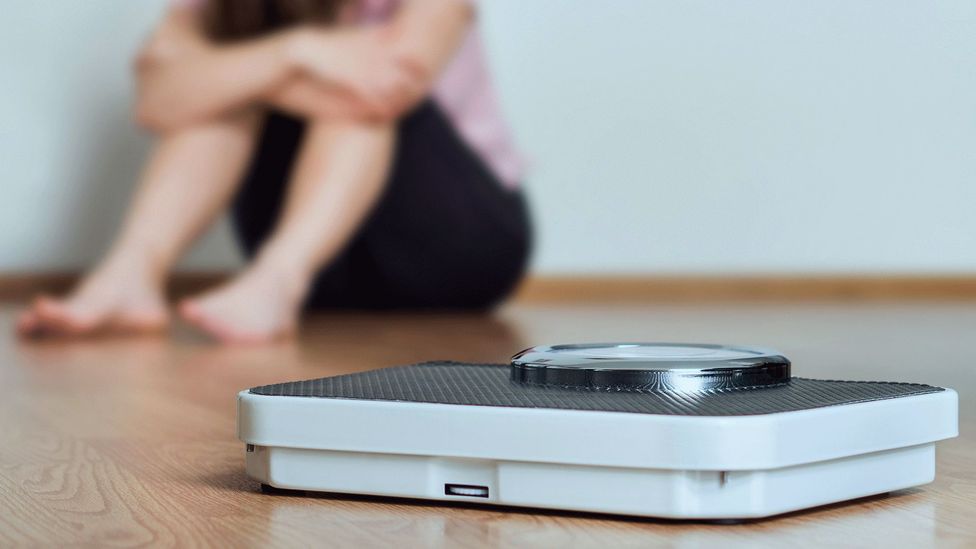
Eating disorders, which often are driven past perfectionism, are on the rise across the earth (Credit: Getty Images)
Where is this increment coming from? When you keep in mind the idea that perfectionism stems from marrying your identity with your achievements, the question might become: where isn't information technology coming from?
After all, many of us live in societies where the commencement question when you meet someone is what you practise for a living. Where we are then literally valued for the quality and extent of our accomplishments that those achievements oftentimes correlate, directly, to our power to pay rent or put food on the tabular array. Where consummate strangers weigh these on-paper values to determine everything from whether we tin rent that apartment or buy that car or receive that loan. Where we then signal our access to those resources with our appearance – these shoes, that physique – and other people weigh that, in turn, to run across if we're the right person for a task interview or dinner invitation.
Curran and Hill accept a like hunch. "Failure is so astringent in a market-based society," points out Curran, adding that that has been intensified equally governments take chipped abroad at social prophylactic nets. Contest even has been embedded in schools: take standardised testing and high-pressure academy entrances. As a effect, Curran says, it'due south no wonder that parents are putting more than force per unit area on themselves – and on their children – to reach more and more.

Rather than perfectionism leading to academic success, researchers take found high-achieving adolescents are more than likely to become perfectionists (Credit: Getty Images)
"If the focus is on achievement, and so kids become very averse to mistakes," Curran says. "If children come to internalise that – the idea that nosotros but tin define ourselves in strict, narrow terms of accomplishment – so you see perfectionistic tendencies start to come in." One longitudinal study, for example, found that a focus on academic achievement predicts a subsequently increase in perfectionism.
Similarly, the gilded-star method of parenting and schooling may have had an effect. If you lot get praised whenever you lot practise something well and not praised when you don't, you can acquire that you're only really worth something when y'all've had others' blessing.
If other strategies, like making children feel guilty for making a mistake, come in, it can get even more problematic. Research has found that these types of parental tactics make children more likely to be perfectionists – and, later, to develop low.
Fear of failure is getting magnified in other ways, too. Take social media: make a mistake today and your fear that information technology might be circulate, even globally, is hardly irrational. At the aforementioned time, all of those glossy feeds reinforce unrealistic standards.

Besides equally reinforcing unrealistic standards, social media gives us more than reason to fear making mistakes (Credit: Getty Images)
Some perfectionism is inheritable. But information technology also arises because of environs (after all, if it were just genetic, it seems unlikely information technology would be increasing then much). Then how can parents annul it? Model good behaviour by watching their own perfectionistic tendencies, researchers say. And exhibit unconditional honey and affection.
"It'due south saying things like 'Yous actually tried difficult at that. I'm proud of the effort you put in.' Information technology'south near creating an environment where imperfection isn't just accepted but is celebrated – because information technology means we're human," says Rasmussen, who co-authored an analysis on how family systems can brood perfectionism. "Or communicating to the kid that dear and care aren't provisional on operation.
"It's the idea that you don't have to be perfect to be lovable or to be loved."
*
Perfectionism tin be a particular challenge to treat. Y'all can train someone to be more self-empathetic in a therapeutic setting. Just if they get dorsum to the office, say, with the same enervating boss and same deep-seated behaviours, a lot of that can go out the door.
Then, of course, there is that widespread (if erroneous) conventionalities that being a perfectionist makes usa better workers (or parents, or athletes, or whatever the task is at hand).
"The difficult part of it, and what makes information technology unlike than depression or feet, is that the person oftentimes values it," says Egan. "If we have anxiety or depression, we don't value those symptoms. We desire to get rid of them. When we see a person with perfectionism, they can often be ambivalent towards alter. People say it brings them benefits."
She's helped her patients by helping them testify to themselves that'southward non the case. If someone says, for example, they need to exercise three extra hours of piece of work at domicile each dark to be good at their job, they might experiment with not doing that for a week. Usually the patient not merely finds that it makes no difference – but that the extra balance might even amend their performance.
I've experimented with some of that letting go myself. It'southward gone hand-in-hand with becoming enlightened when I'm taking on too much and exhausting myself in my try to exercise 'plenty' (an corporeality, I've realised, that for me doesn't actually exist).
The bigger piece, though, is replacing that critical ticker-tape with kinder letters – toward both myself and others. I've started (with varying success) consciously stopping myself from overreacting to other people'due south mistakes. More difficult, but also of import, has been stopping myself from overreacting to my own. Ironically, that includes trying not to criticise myself when I fall brusque of that goal in itself.
It'southward a piece of work in progress. But what I've noticed is that, each time I'm able to replace criticising and perfecting with compassion, I feel not only less stressed, but freer. Apparently, that'due south not unusual.
"Information technology tin exist liberating, assuasive imperfection to happen and accepting it and celebrating it," Rasmussen says. "Because it's exhausting, maintaining all of that."
Amanda Ruggeri is the special projects editor and a senior journalist at BBC.com. Y'all can follow her on Twitter at @amanda_ruggeri.
Bring together 800,000+ Time to come fans by liking united states on Facebook, or follow u.s.a. on Twitter.
If you liked this story, sign up for the weekly bbc.com features newsletter, called "If Yous Merely Read 6 Things This Week". A handpicked selection of stories from BBC Future, Earth, Civilization, Majuscule, and Travel, delivered to your inbox every Friday.
freemanmaddeauttle60.blogspot.com
Source: https://www.bbc.com/future/article/20180219-toxic-perfectionism-is-on-the-rise
0 Response to "Mary Oliver I Want to Think Again of Dangerous Things Print With Feather"
Post a Comment